


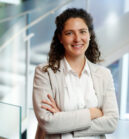
Carol Seregni

Carol Seregni
  • Harold C. Stott Assistant Professor
  • Assistant Professor of Accounting

Contact Information

  • office Address:

    1313 Steinberg Hall - Dietrich Hall
    3620 Locust Walk
    Philadelphia, PA 19104/6365

Links: CV

Overview

Carol Seregni is an Assistant Professor of Accounting at the Wharton School. Her research focuses on disclosure regulation and firm transparency.  Professor Seregni completed her doctoral studies at the University of Mannheim and held a two-year non-degree visiting Ph.D. position at the University of Chicago, Booth School of Business. She received a Master of Science in Accounting, Financial Management, and Control from Bocconi University, a Master in Management from the University of Mannheim, and a Bachelor of Science in Management from Bocconi University. She is currently a research fellow at TRR 266 Accounting for Transparency.

Continue Reading

Teaching

All Courses

  • ACCT1010 - Acct & Financial Report

    This course is an introduction to the basic concepts and standards underlying financial accounting systems. Several important concepts will be studied in detail, including: revenue recognition, inventory, long-lived assets, present value, and long term liabilities. The course emphasizes the construction of the basic financial accounting statements - the income statement, balance sheet, and cash flow statement - as well as their interpretation.

  • ACCT9410 - Research in Acct II

    This is Part II of a theoretical and empirical literature survey sequence covering topics that include corporate disclosure, cost of capital, incentives, compensation, governance, financial intermediation, financial reporting, tax, agency theory, cost accounting, capital structure, international financial reporting, analysts, and market efficiency. Please contact the accounting doctoral coordinator for information on the specific upcoming modules/topics that will be taught.

Knowledge at Wharton

When AI Transparency Backfires

New research shows that AI and machine learning models can be made to look fair and neutral in their interpretability outputs while continuing to produce biased real-world decisions.Read More

Knowledge @ Wharton - 5/5/2026
Five Things to Know About Private Credit

As investor withdrawals and liquidity concerns rattle the $1.8 trillion market, Wharton’s Itay Goldstein explains how private credit works, why experts are uneasy, and what it could mean for your finances.Read More

Knowledge @ Wharton - 5/5/2026
Why Women Need Other Women at Work

A new study on gender homophily in remote settings found that women who attended virtual career training did better when their classes did not include men.Read More

Knowledge @ Wharton - 5/5/2026